Orbifolds
In the context of Quantum Field Theory an Orbifold is a QFT where we have gauged a finite group. This set of notes will introduce the idea of gauging finite groups, provide a historical disclaimer that bridges the early string theory view of orbifolds to the more modern interpretation, and finally provide calculation tools for a set of examples that we already know how to solve known as cyclic. We will also see what fails in the general case.
Here are some resources or supplemental reading for these notes.
- The Operator Algebra of Orbifold Models
- Gauging Non-Invertible Symmetries and the Generalized Orbifold Groupoid
- Operator Algebra of Cyclic Orbifolds
- Systematic Approach to Cyclic Orbifolds
Orbifolds
Historical Disclaimer
Gauging Discrete Groups?
Gauging Lie Groups
Why Averaging Works
The Problem with Discrete Groups
Gauging Discrete Groups using Defects
10s Review of Symmetry Defects
Interlude: What happens when
Summing Over Networks of Defects
Orbifolds Get Rid of Local Fields
Orbifolds Introduce New Local Fields
Calculating Orbifolds
The Ising Orbifold
Local Operators that Survive in the Orbifold
Nonlocal Operators that Turn Local in the Orbifold
Gauge Duality
Cyclic Orbifolds
Roadmap
The Chiral Algebra
Modular Covariance is Still a Thing
Historical Disclaimer
This section is here solely to clear up confusion with String Theory orbifolds. They are the same thing, but the intuition surrounding how they're presented is not easily generalizable to the modern view of orbifolds. The rest of the notes are not going to use this chunk so feel free to skip.
The modern view of orbifolds, as QFTs with a gauged discrete global symmetry group, is not usually discussed in standard QFT/String Theory courses. People with the good fortune of taking a string theory class, however, had most likely encountered the term orbifold referring to a particular Conformal Field Theory (usually a version of free boson or free fermion) with some version of messed up boundary conditions.
To be more concrete, let's pick up the free boson. This is a conformal field theory, where the field we are quantizing is a way to assign an element of a real line on every point in spacetime. In the tradiational fashion of CFT we choose to think of lines as really big circles (this is done for IR completeness reasons). As a result, for a string theorist, the classical field we quantize in a free boson CFT doesn't assign an element of a line everywhere, but an element of circle (with possibly infinite radius) instead. This creates a family of "free boson CFTs" classified by the radius of the circle the free boson itself is valued in.
The orbifold in this context arises if we consider the following. "Why not identify the antipodal points of the circle that the free boson takes values in?" In other words, instead of having the free boson assign an element of a circle at every point, why don't we fold the circle in a weird way, and have the free boson assign an element of that folded thing at every point. One is probably already screaming that what we really did was put boundary conditions on the values the boson can take. A mathematician would say that we replaced the circle with one of its orbifolds. And so the name stuck.
Turns out this can lead to a well defined (i.e. local, unitary, blah blah) Conformal Field Theory! Unfortunately this is where the intuition stops. What we secretly did when adding these boundary conditions on the free bosons, or swapping the target space with an orbifold, was actually gauging the discrete group
In the remaining of the notes, we talk about orbifolds from scratch without making reference to this construction. Once we define orbifolds using discrete gauging we will then make the connection between the two ideas.
Gauging Discrete Groups?
I've mentioned a couple of times that Orbifolds are really gauge theories, where the group we are gauging is discrete. However, depending on how one thinks of gauge theories this might seem nonsensical.
Gauging Lie Groups
This should really be called Gauging Lie groups with dimension
Usually, "gauging a global symmetry" means the following. Use your Lagrangian
Once you have identified your global symmetry
If
Why Averaging Works
The reason why this is true is worth paying close attention to when it comes to generalizing this idea to discrete groups. So let's look at an example outside of QFT for a second.
Consider the group
Now
Any element in
Anything you calculate in a gauged theory will contain sum over copies of the calculation but with all possible gauge fields you can put. Pick a region in spacetime, and act there with
In practice there are a lot of things to consider when extending the above intuition to a healthily defined QFT. Often one needs to account for degeneracy in the possible
The Problem with Discrete Groups
At this point, it is natural to say: "Ok, let's gauge a discrete group in an identical way. Find all the gauge fields that correspond to its action and then sum over them." In fact, a lot of textbooks would say exactly that. However, that is really an abuse of notation, and there are a couple of meaningful subtleties for us to take into account.
- The Lie algebra of discrete groups is 0 dimensional. The traditional techniques we have for gauging Lie groups tells us that gauge fields are valued in the Lie algebra of the group we want to gauge. So it seems that there really aren't many gauge fields for a discrete group. They're all zero. This is partly true, and examining the consequences of this intuition will give us an answer for how to gauge a discrete group.
- There are QFTs with no Lagrangian. How do we even begin to think about gauging in those?
Both of these observations motivate us to more carefully examine gauge fields, and perhaps indicate that we should try to rethink of how we couple a gauge field to our theory. Thankfully, we have an answer to both, and that is defects.
Gauging Discrete Groups using Defects
A topological defect is so closely related to a coupling of a gauge field to a QFT (some people say that it straight up is that). In our case, it is the perfect alternative alternative viewpoint of the same thing to help us reframe how we think about gauging. A quick review of topological defects for symmetry purposes can be found here. For the purposes of these notes, we will only use the intuition of the first section in that reference.
10s Review of Symmetry Defects
Defects can help us make precise the idea of a Symmetry Operator in a QFT. Imagine you have a global symmetry
You know though, that since
where
In general we shouldn't expect that
This can be thought of as applying the global symmetry in a region
that containsbut not. This way only insertions atwill be transformed by the global symmetry. There is no reason to think that that messed up non global application of theaction would still be a symmetry of the theory.
This leads to an interesting question. Is there an operator associated with this half-implementation of the symmetry associated to
The realization that is key to help us understand that object better is that since
This is what people mean when they say, that a global symmetry operator is a codimension 1 topological defect. In this case, if we call
We call
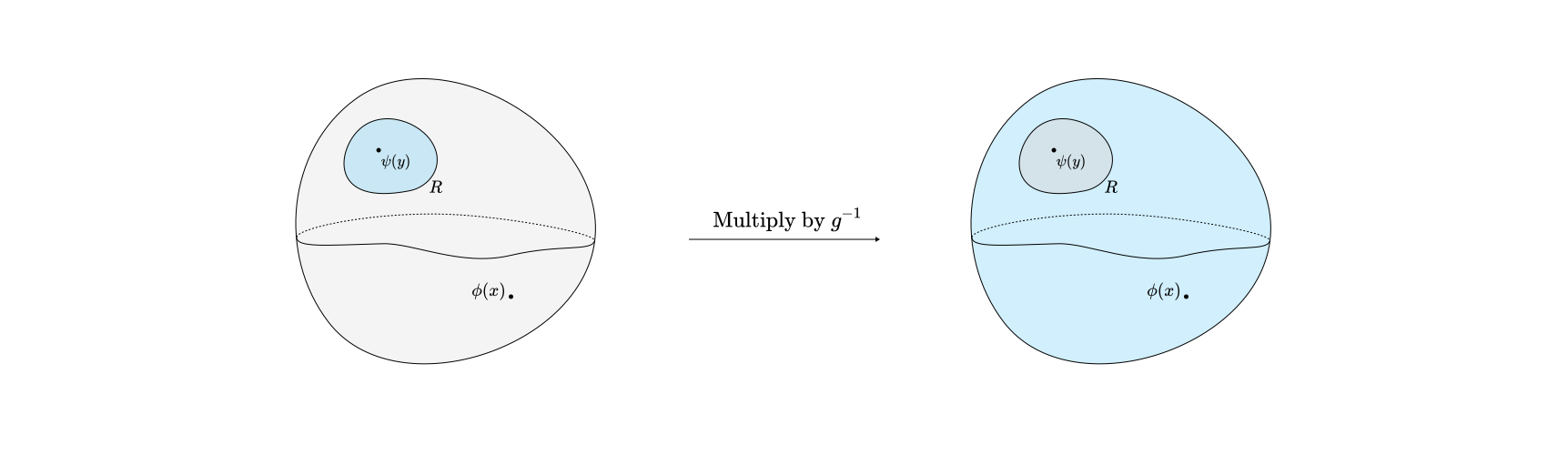
One last interesting point, is that if we fix the point
It is worth reflecting on what we created. The topological defect line
seems to do to our fields what a gauge field would do. It applies the global action ofin a random region in spacetime enclosed by!
Interlude: What happens when
So far we have considered defect operators that are associated with boundaries of regions in our 2D CFT. One might wonder if it is possible to consistently define a defect operator on a Line that is not the boundary of something, or in other words, a line with endpoints.
It is not unreasonable to conceive such an operator. In fact, we already know a lot about hot it behaves. If we insert it in a calculation of a correlation function, then when other insertions cross the line, they still feel the action of the group. The line (with the exception of the end points) is still topological even if the endpoints must remain fixed.
The real confusion is what happens at the endpoints. Since the Line is singular as hell, the endpoint of it will also be something akin to a singular point. At this moment it is important for us to realize, that we in fact know how to treat singular point insertions in QFT. We call them local operators. Field operators, like
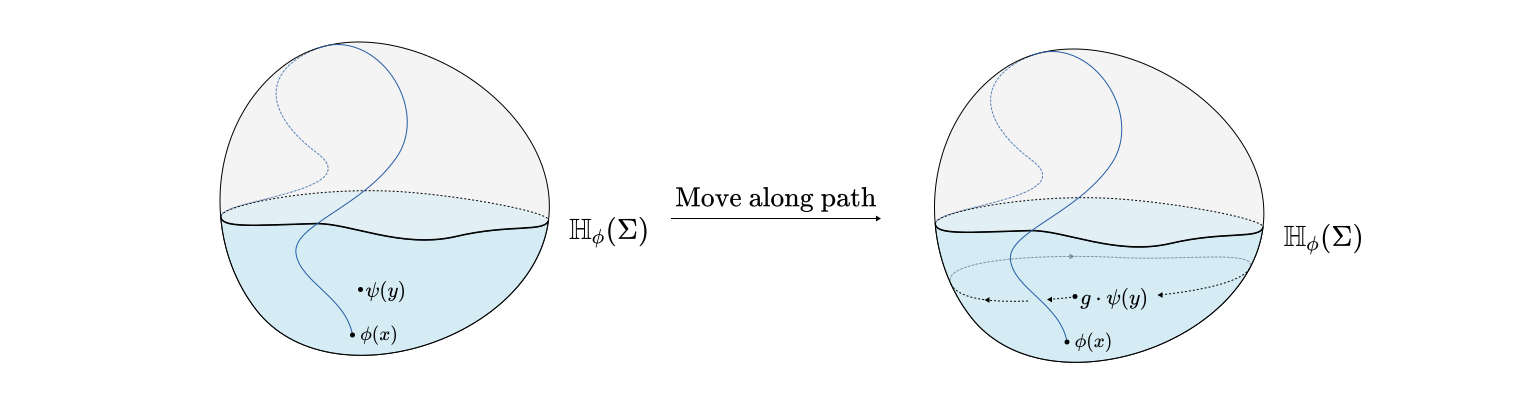
So how can we think of the endpoints of the defects? We can think of them as point-like operators but with the particular monodromy (or branch cut) defined by the defect line.
These operators are not local. The reason being exactly that monodromy condition. Their OPEs have branch cuts! From an operator content point of view, while field operators would appear in the set of local operators of the theory, defects with endpoints would not!
We have already encountered some defect endpoint operators when studying Renyi entropies. We called them twist fields. In fact twist fields corresponding to global symmetry actions play such a major role in gauging. They are often quite hard to find, and the reason why discrete gauging is not solved is because we don't have a process of figuring out twist fields in general. We will soon see examples of calculating them in theories where orbifolding is solved.
For now, the key thing I want to elude to without justification is while such twist fields are not local operators in the main theory, they become local operators in the orbifold. Which is why calculating things like Renyi entropies in the orbifold as correlation functions of defect operators, not only makes sense, but is also tractable.
Summing Over Networks of Defects
With this interlude over, let's go back to the realization in the last box. Using idea that applying a global symmetry in some random region enclosed by
A gauge theory in this language is a QFT where anything we can calculate remains the same, if we insert an arbitrary topological defect line associated to a global symmetry
Two defects corresponding to two group elements
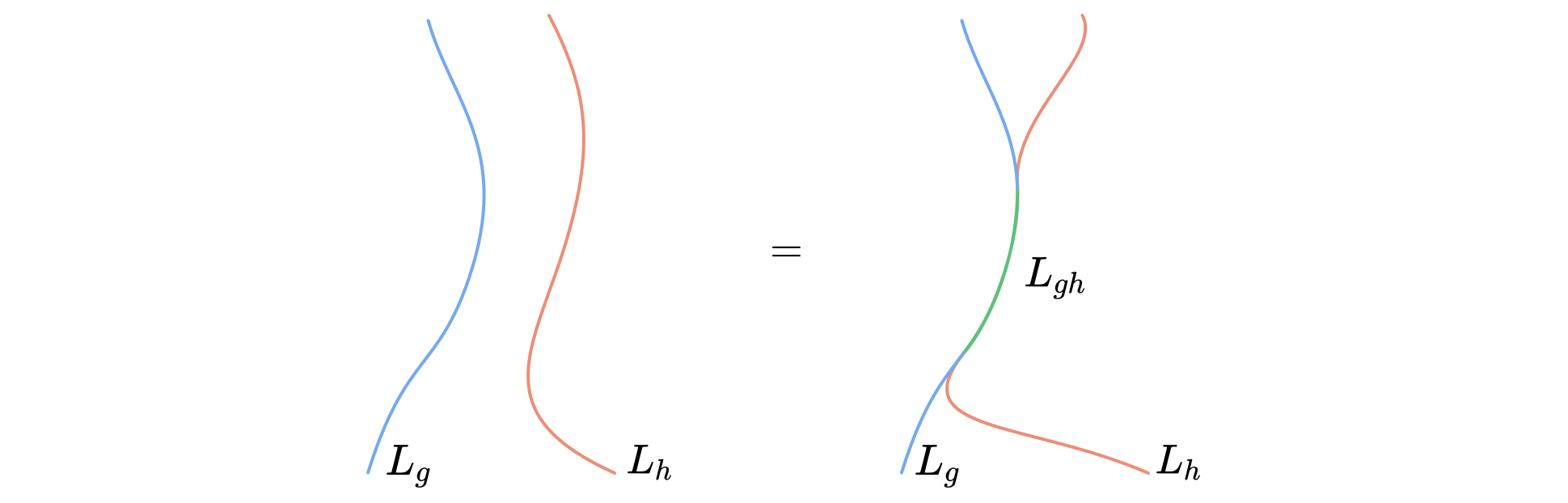
So what if we could find a defect
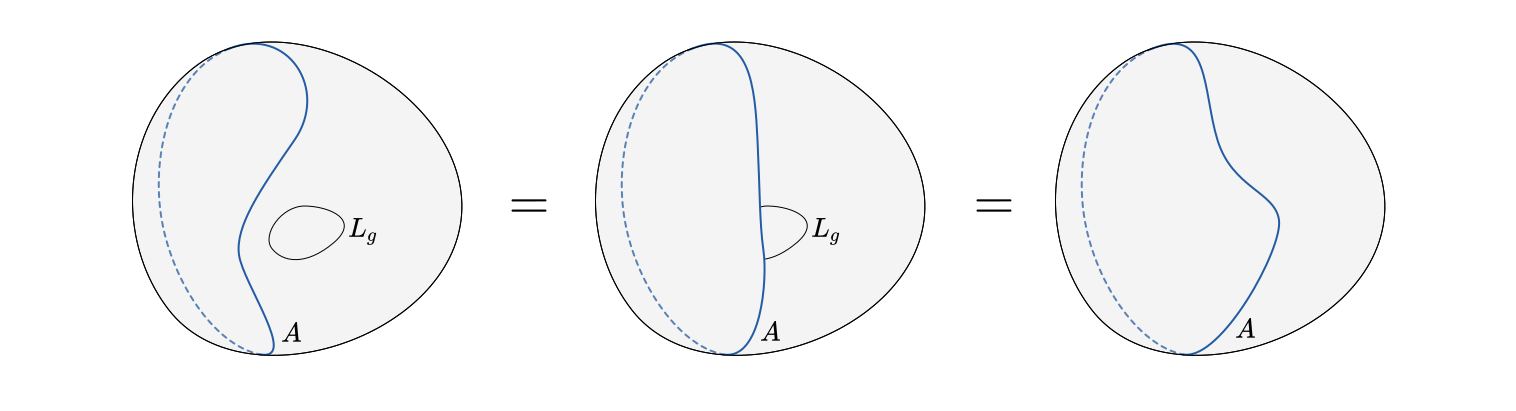
But what should that
We have already seen how the fusion of A with any defect corresponding to a
which is so dangerously close to averaging over all possible defect configurations that correspond to
That might seem like we took one step forward and 2 steps back because summing over all lines is insanely complicated. That is until we realize that we don't need to do that. Most complicated meshes of
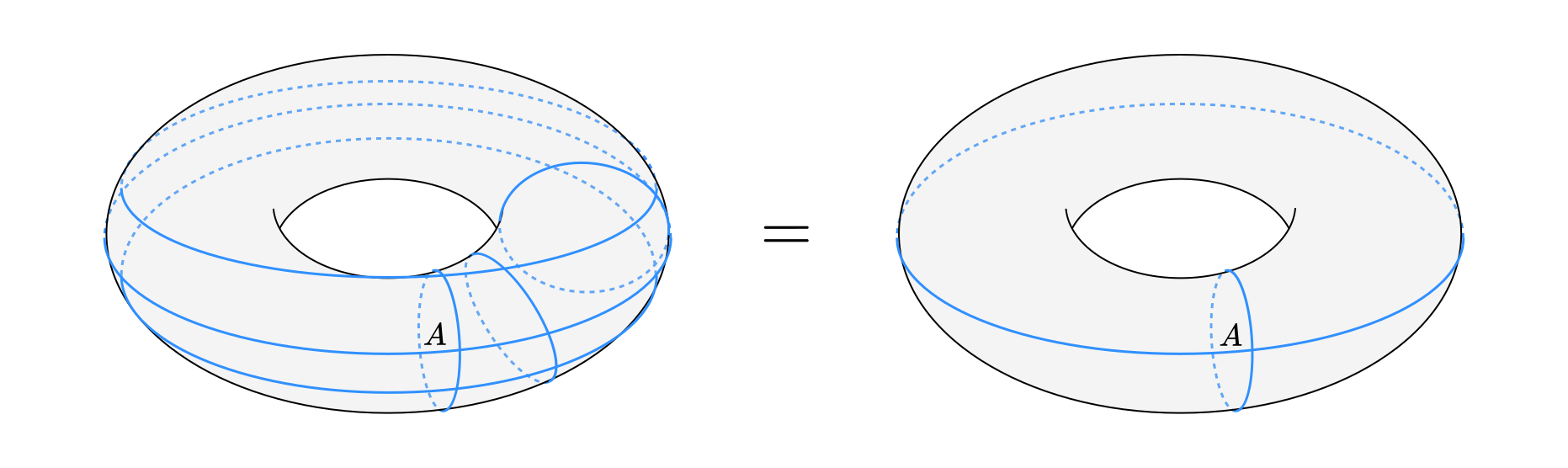
This is an incredible result, and also really enlightening in actually calculating the orbifolds. In fact this generalizes for any finite abelian group
Orbifolds Get Rid of Local Fields
Before we proceed with the actual calculation, we have developed a really robust framework to guide our intuition. It would be a shame not to use it to predict what we expect from our calculations.
Just by
In other words, if
Since we can freely deform
This generalizes. The only fields (or states) that will survive gauging are the ones that are invariant under the action of
Orbifolds Introduce New Local Fields
This is the trickiest part of orbifold calculation. In the interlude above we explored how a defect operator can end at specific points onto which we attach something like a point-like operator but with a monodromy condition that makes it have non-local OPEs.
However, in the presence of an
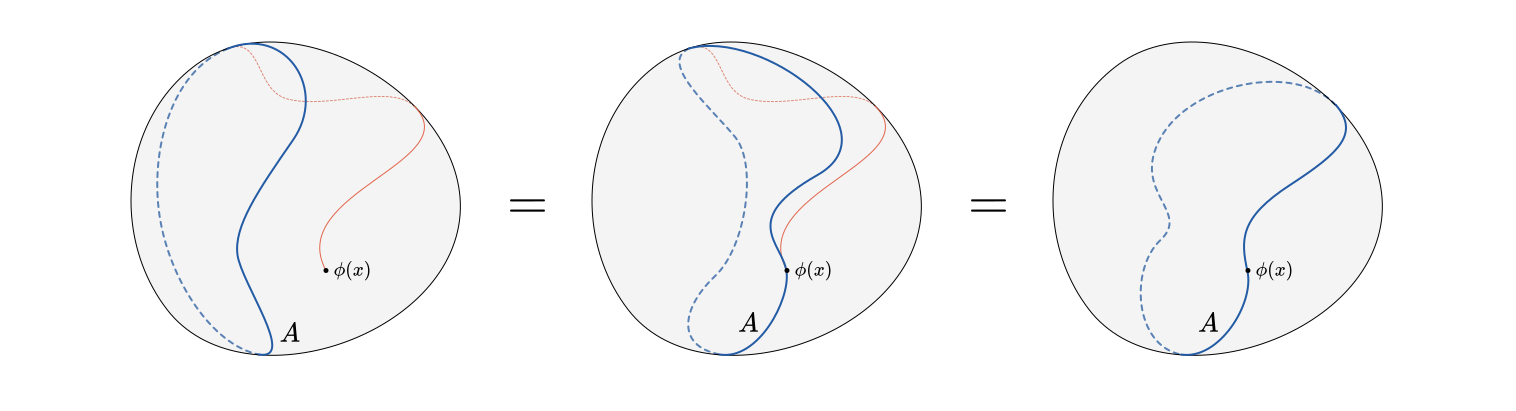
This is a blessing and a curse. It is a blessing because we have all this machinery of working with local operators so it would be nice to convert a nonlocal calculation to a local one by moving to the orbifold (which is what we do in Renyi entropies). It is a curse though because in order to even find the orbifold we need a way to take a theory and find all of its operators that could have a brunch cut in order to see which of them appear in the orbifold out of nowhere. This is not solved and can be quite involved even for relatively simple theories.
But with these main things done, we are ready to start calculating.
Calculating Orbifolds
So far everything here is pretty general. We only used a 2D CFT as a playground to draw some pictures, but these arguments hold in most QFTs. But even though they hold, actually calculating them in a general QFT setting is a nightmare. So in this section we will do some calculations in a particular subset of CFTs known as Rational. For Rational CFTs we have figured out how to gauge any finite abelian group which is pretty nice!
Rational CFTs include bosonic CFTs encountered in string theory, free fermions, almost all of the 2nd order phase transitions in Statistical mechanics, plus they are what pretty much everything flows to under RG so it's a wide enough class for figuring out orbifolding is not a minor thing. We will first start with a very simple example, the Ising model which has the property that it is its own orbifold. Once that is done, we will introduce aspects in the calculation of cyclic orbifolds, in other words gauging
This section requires some more CFT terminology like primary fields, modular invariance, S-matrix (the modular not the scattering one), and Chiral Algebras as well as some familiarity with the state operator correspondence.
The Ising Orbifold
Here is why the Ising CFT is the easiest example to orbifold. Unlike something like a free boson, which has infinite primary fields (all the modes of the free boson), the Ising CFT has three, one of which is the freaking identity. They are usually called
and have conformal weights
Every other field in the theory is a Virasoro descendant of one of these three. In fact we often write the Hilbert space of the Ising model like this
where
as the vector space that takes a primary
One symmetry of the Ising orbifold is the spin flip. This is a
[!TIP]
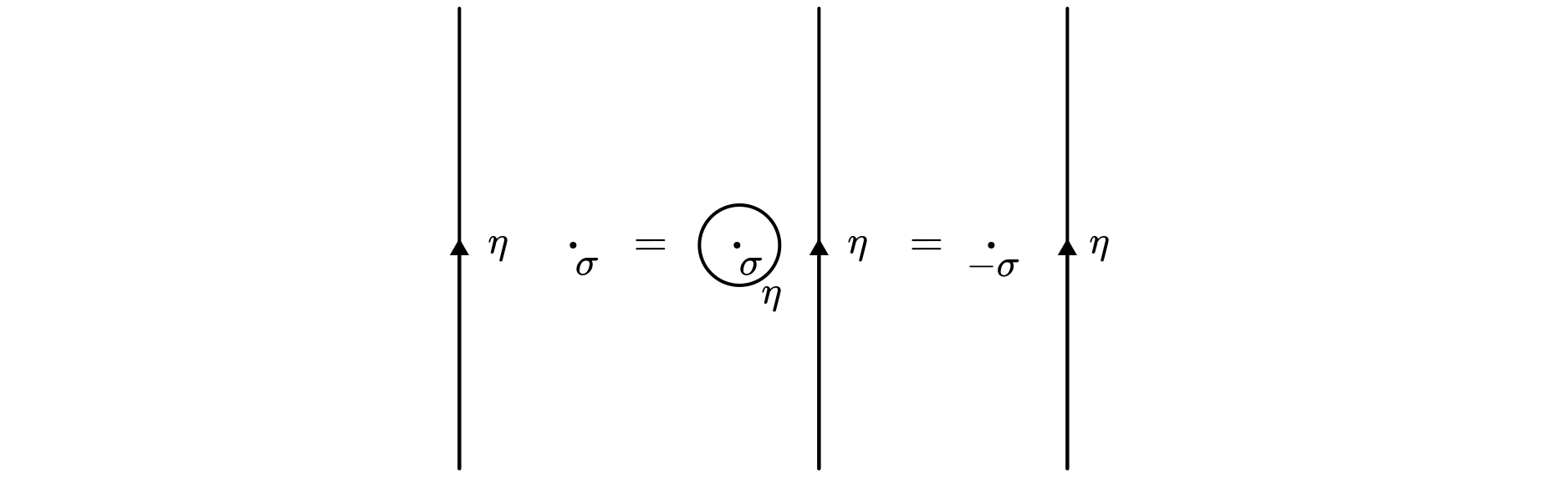
Here is an example for how to read these relations. The relation
is that if we have an insertionat some point in spacetime, and then we move it across thedefect, thenwill pick up a minus sign. In this case we see that thedefect does nothing on all primaries except flipping the sign of.
Here is a picture of the above relations.
Local Operators that Survive in the Orbifold
Let's try to gauge the
The first step we have to do is to see which operators from the original Hilbert space would survive. These are the invariant operators under the
However, as we said before, operators that were nonlocal in Ising, might become local in the orbifold! So we need to somehow find all the nonlocal operators in the Ising model with monodromy
Nonlocal Operators that Turn Local in the Orbifold
This is not easy to do in general. However, in the Ising model (and all other minimal models), modular covariance of the theory fully restricts the kind of defects one has available. So let's take a momentary detour to see how.
State operator correspondence is a thing in CFT, which means that if you know the Hilbert space at some slice, you can reconstruct the operators used to create these states. So we will shift our attention to look for the Hilbert space at some spatial circle instead. Let's go on the sphere, and consider what would it mean to add one of these nonlocal defect operators that have endpoints.
Consider an
This is where modular covariance comes in. One of the most amazingly powerful results of CFT, is that in a modular invariant theory, one can consistently define it in any Riemann surface and the Hilbert space remains the same! As a result, we can pinch the poles of the sphere together, and add it on our torus. On its face this might not seem to help us calculate the Hilbert space, but we remember modular covariance. On the torus, the S-transformation exchanges the two cycles. So we can use the S transformation to map between the defect placed on one cycle vs the other. Doing so help us tremendously, because we actually know how to calculate the Hilbert space with the defect inserted in the other cycle. Once we do that, we simply S transform that, and we obtain the Hilbert space with the defect inserted along the original cycle! This requires a lot of pictures to make sense, so here they are.
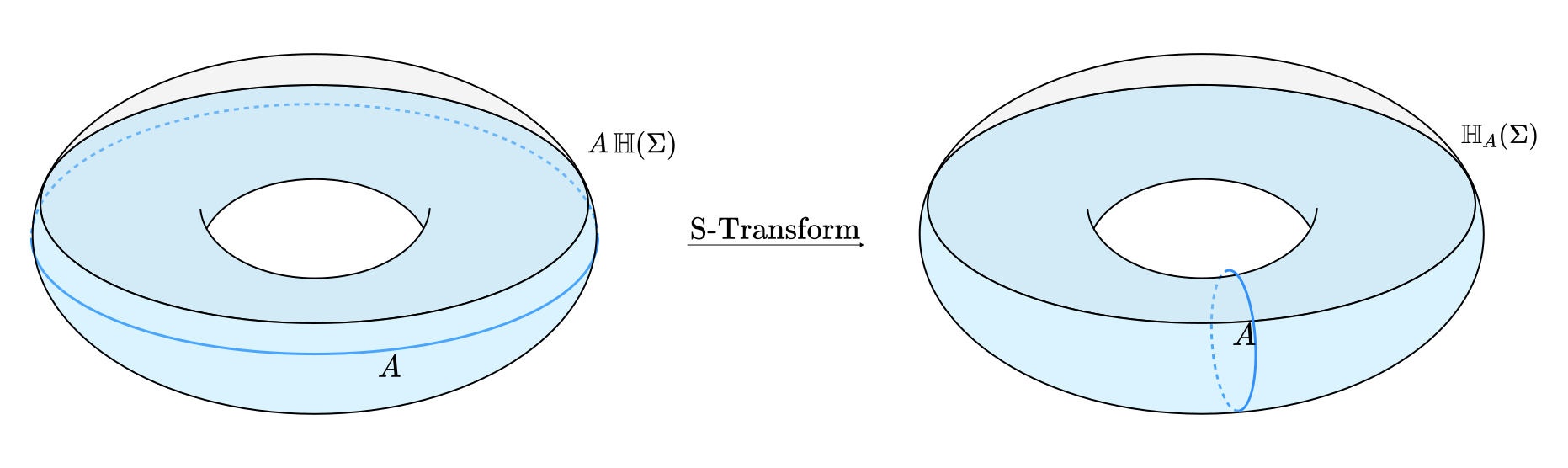
Using pain and some things beyond the scope of these notes, one can calculate that the modular transformation of the original Hilbert space in the presence of the
We usually call the Hilbert space
Figuring out the action of
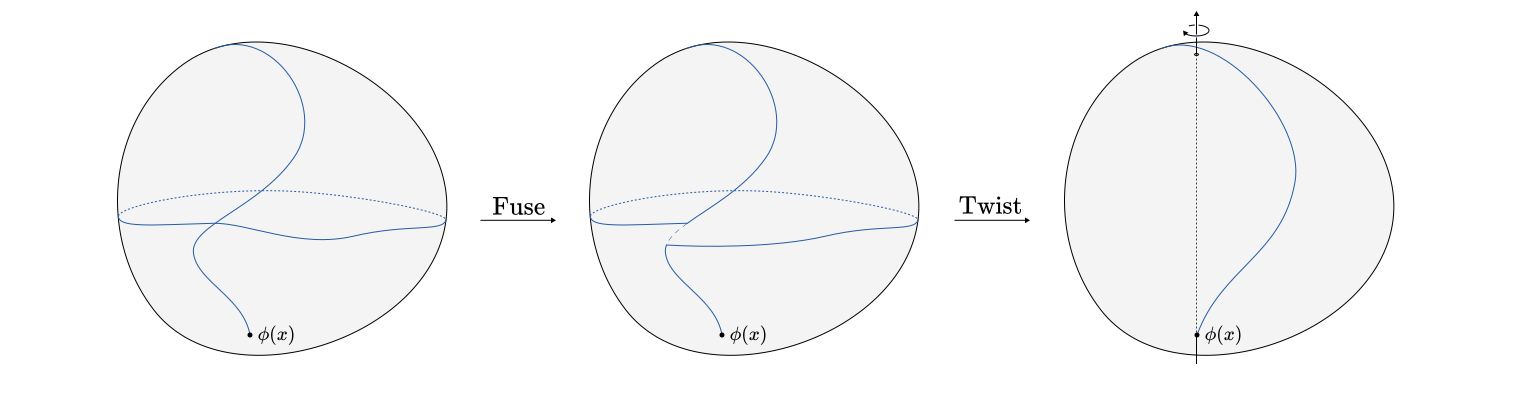
It looks like we twisted (like an actual grab and rotate twist not a theoretical twisted operator twist) the sphere around the poles, which would correspond to the
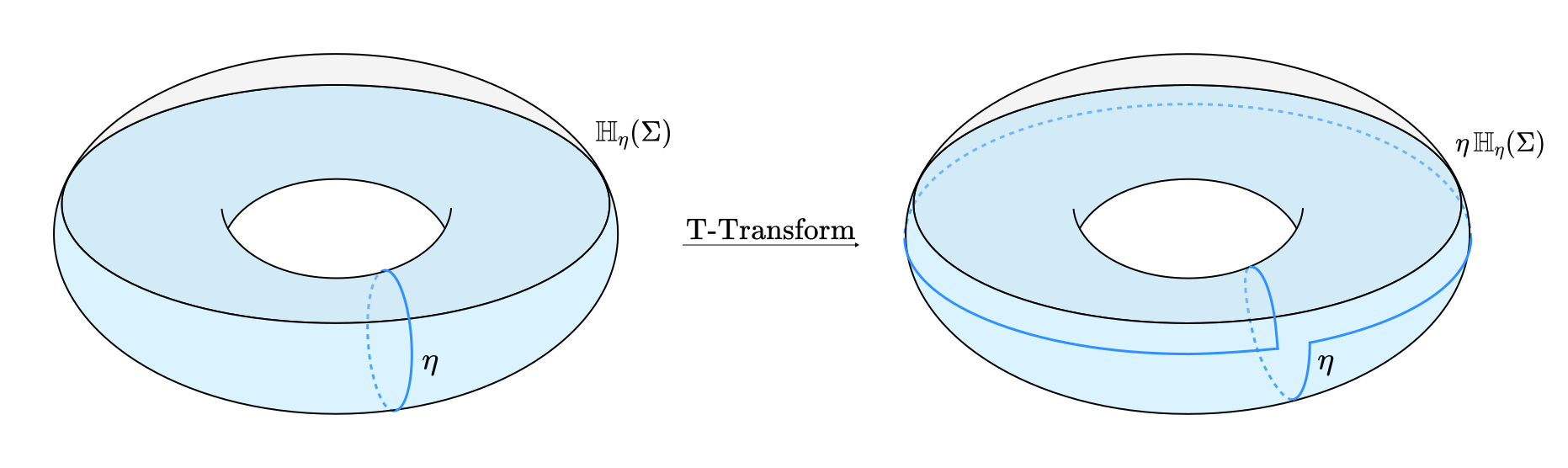
Finally using the
which is equal to the unorbifolded Ising Model! This is not something that happens in general, this example of CFT and defect, was chosen specifically so we observe that. If we were to try to gauge a different symmetry of the Ising model we wouldn't get back the same thing. But this leads to an interesting concept.
Gauge Duality
Oftentimes people refer to gauging in a CFT as some form of duality. However, in face value, it seems like gauging would remove information from the theory, since we took a global symmetry and made it local, effectively projecting out states (or fields) that were not invariant under the global symmetry. However, we caught a glimpse of how we both lose information, by projecting out, but also gain information, by including things from the twisted sectors.
In some sense, gauging simply rearranges the content of our theory. It doesn't remove any information.
Since we didn't lose any information overall, we could in principle undo gauging. A general fact is that if we take a theory and gauge some group
It is in this sense that people refer to gauging as a duality. It can help us map between different theories with the same "content." This is really fascinating, but these notes are way too long already and I need to calculate things about cyclic orbifolds. There is a reference at the top.
Cyclic Orbifolds
While symmetries of minimal models are fun to gauge, they are not as universally used as cyclic orbifolds. These have great applications in the calculation of Renyi entropies as well as other areas of QFT like classifying RG flows, and more. Let's start though by thinking of them as their own thing first.
Roadmap
Calculating an orbifold really means finding its operator content. If we have that, then we can calculate correlation functions, partition functions, and whatnot. Let's take a second to review how we did it in the Ising case, and point out what we need to take care of now.
-
We start with a rational CFT with Hilbert space
-
We then take
-
We define a permutation symmetry for our copies. In other words, one symmetry of the fold theory is to permute the copies of the original theory. Correlation functions wouldn't even know about it. The symmetry group is
-
Find out the defects that correspond to
-
To find the operator content, project out the states that are not invariant under
-
Find out what the twisted Hilbert spaces that correspond to each
-
Combine all of these together into the Orbifold Hilbert space.
The Chiral Algebra
What helped us deal with the Ising orbifold was using modular covariance to constrain what the twisted Hilbert space could be for the defects we were gauging. We did this by explicitly writing down the Hilbert space of the theory in terms of irreducible representations of the symmetry algebra of the CFT. By realizing that they were finitely many made it tractable to use modular covariance, i.e. S and T transformations on a torus, to constrain what it would look like.
Where there infinitely many irreducible representations we wouldn't have been able to work out the S transformation of the characters. Unfortunately this is the case with most conformal field theories. Even well defined, i.e. local, unitary, CFTs with
There is a silver lining to this, however. In a large class of them, called rational CFTs, It is possible to combine the infinitely many Virasoro irreducible representations into finitely many irreducible representations of a larger symmetry algebra known as the Chiral Algebra. This is the tool that we will use in order to essentially reuse the techniques we discovered in gauging the spin flip defect in the Ising model.
A rigorous attempt to define the chiral algebra using the existing Hilbert space is not illuminating. Instead, we can think of the chiral algebra as the Lie Algebra that has generators all the modes of the conserved currents in the theory. Since the stress tensor is conserved, and its modes form the Virasoro Algebra, any chiral algebra
However, say that there are more conserved currents in the theory. Taking a Virasoro primary and acting with the other modes can result in obtaining a field in a different Virasoro representation. Therefore an irreducible representation of the larger algebra is going to contain multiple Virasoro ones. In rational models it just so happens that it contains enough so that when the Hilbert space is written in terms of