Warm Quantum Fields
What happens when there is more than a couple of particles in space? We will use thermodynamics to introduce perturbative corrections to QFT calculations. We start with a revision of the basic structures in statistical physics, formulated in a more abstract way such that it is directly applicable to the path integral formalism. Then play with the partition function for QFTs enough to derive corrections to the Green's functions of the theory and finally do some perturbative corrections to show that the temperature is meaningless and we were right to ignore it all along.
These notes rely on:
- Kapusta - Finite temperature field theory
- Bellac - Thermal Field Theory
- Ramond - Field Theory
- Donoghue - The analytic continuation of distributions
- Peskin - Introduction to Quantum Field Theory
- Tong - QED
- Weldon - Covariant Calculations in Finite Temperature Field Theory
- Ahmed - Vacuum Polarization at Finite Temperature in QED
Warm Quantum Fields
Ensembles
Quantum Mechanical Canonical Ensemble
Physical Motivation
Partition Function
Partition Functions in QFT
Aside on Complexification
Transition Amplitudes
Free Theory Partition Functions (Intuition)
Free Bosonic Theory Partition Functions
Theories with Interactions
The Generating Functional
First order corrections to the propagator
Real Time Formulation
Feynman Rules for
Complex Time ordering
Propagators
Contours for the Real Time Partition Function
Relating to the Propagators
Self Energy
Finite Temperature Gauge Theory
Incorrect Free Energy
Rescuing the Free Energy with Ghosts
Photon Self Energy at Finite Temperature
Spontaneous Illegal Interactions
Ensembles
The playing field of statistical physics is ensembles which is a term that comes from probability. The idea is that one has a measure space that denotes all the possible outcomes for the big system and then they add a probability measure that satisfies certain physical conditions such as the existence of temperature or chemical potential and so on.
The definition of an Ensemble is useless because it is too general, but here it is but that's too abstract to make sense.
Definition: An ensemble
The definition of the other components is here and honestly it isn't even that relevant. An ensemble is basically a space
The physics of the ensemble are all inside
Quantum Mechanical Canonical Ensemble
It is actually worth to go through this as an example because it will force us to think about interesting topics such as the spectral theorem and so on, plus it will be a useful motivating intuition for our subsequent definitions.
Example: (Quantum Canonical Ensemble) Consider a quantum system with Hilbert space
In any physical theory one doesn't just get the Fock space by itself, but also gets an algebra of possibly bounded self adjoint operators
Given all that, we need to convert
Definition: The projective Hilbert space
Corollary: The projective Hilbert space is isomorphic to the set of all projection operators to the lines in
The projective space has a natural Khaler manifold structure with metric induced by the inner product in
Theorem: Consider a complex Hilbert space
where
This is way too complicated for what it is. It just means that the probability norm we are using for the born rule defines a metric on the projective space and more importantly a volume form there, including a measure.
Example: Let
This can be thought of as their angle in the projective space which belongs in
We actually don't care to measure
Theorem: (Gleason's Theorem) I probability measure is a Fubini probability measure
where
Note that the integral of the Fubini form on
Intuition: In physics we call
a density matrix. The above theorem can be rephrased to any density matrix defines a distribution over the projective space.In particular, the configurations in quantum mechanics are really only the elements projective space of the Hilbert space. This is the rigorous form of the statement: "Physical states are equivalent up to a phase." As a result, the density states are essentially a probability distribution over the set of such configurations.
In a more quantum mechanical language a density matrix can be thought of as the probability distribution that a quantum system would collapse to a specific state after observation. For example, the density matrix
in a spin-system is a probability distribution over all the possible quantum states that after observation the system would collapse to thestate.This is similar to classical statistical mechanics, where the density of states is a distribution over the classical configurations.
So now we can add measures using density matrices which is honestly pretty cool! We are ready to define an ensemble.
Definition: Consider a quantum system with Hilbert space
where
where the last equality is given by the spectral theorem.
And here we have it! A fully fledged ensemble! Probably not the best first example for this, but this can serve as a blueprint for the later definitions.
Physical Motivation
Notice that the grand canonical ensemble is the ensemble given by the density matrix
Let's go over the physical motivation for this. The grand canonical ensemble is supposed to describe a system where there are a bunch of particles at some fixed temperature that is connected to a reservoir such that adding or removing particles expends a fixed amount of energy. The total energy remains constant though. Let's motivate each condition separately.
Such a system thermodynamically has to obey the first law of thermodynamics which in this case is written by
where we define the number of microscopic states that correspond to a particular macroscopic state to be
by where
Now assume that the reservoir is much bigger than our system. This really means that if we change its state variables the reservoir won't budge. To be more precise, we focus on the Reservoir. It is a system whose total energy is given by
where
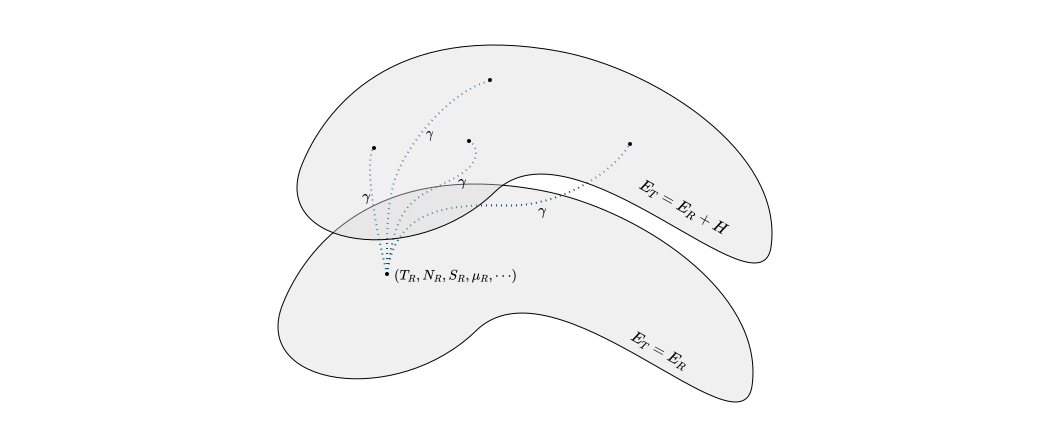
What the condition means is that these surfaces are physically close in the configuration space. In other words, for every path
where
Therefore we can now calculate the difference in entropy. This directly leads to the weighting factor we have introduced above.
Partition Function
Almost by accident we got introduced to the partition function in the definition of the grand canonical ensemble above as this normalization constant. It very often happens to be a smooth function and it can give us information about all thermodynamic observables by taking appropriate derivatives of it. In some sense, one has an Ensemble simply by knowing the partition function.
To see how that is true we will first define the average of observables in our thermodynamical system.
Definition: Let
where the integral is the Bochner integral (generalization of Lebesgue integral for Banach spaces).
With this we can see that the partition function is very close to the ensemble average. In particular the partition function helps us define a probability measure using a volume integral.
Proposition: Let
where
Proof: Clearly
So in some sense, the partition function can help us relate one measure as a function of another, but it can also help us obtain ensemble averages. Specifically check out this example.
Example: (Cool stuff on manifolds) Let
Then one can define the collections of probability measures
The proof for this is through the following calculation
This is a pretty powerful fact, because usually in thermodynamics
Given such a successful construct we would like to use it in our path integral formalism.
Partition Functions in QFT
As we have seen in the previous section a partition function doesn't exist without a reference to a measure. In quantum field theory the configuration space is a projective space of a Fock space that is comprised out of all the field operators. There we have introduced a measure called the path integral that allows us to integrate over everything and assign probabilities to each state just like in the quantum mechanical grand canonical ensemble we saw in the previous example. We want to find the partition function with respect to that measure in such a way that it encodes the idea of temperature.
Aside on Complexification
Let's begin by considering what is the condition under which one can continue a real valued distribution to a complex analytic function in some sense. Let's first define the object that would make sense in this context.
Definition: Let
Recall that
Theorem: Let
if and only if for all such test functions
This result is what facilitates Wick rotation in field theory. The fields are such distribution valued functions usually with discrete singular support.
Transition Amplitudes
In Quantum field theory we want to calculate things like the amplitude that a state, after time evolution, will evolve to a different state. These are called transition amplitudes and can be calculated with the path integral prescription that we briefly describe here.
To make this more precise consider the eigenstates of the field operator
where
where the domain
where
Free Theory Partition Functions (Intuition)
These path integrals are really only well defined in free theories. So let's try to do one derivation and then we can move on to the interacting ones.
We have seen from the previous example of the quantum mechanical phase space that the appropriate partition function is given by
where
Specifically, we would have (up to an overall factor that we divide out in all calculations)
where the integration is carried out over all field configurations. The cool thing is that we are already familiar with such constructions because we can Wick rotate. In other words, we analytically continue our fields to the complex plane such that plugging in
Now is where things get suuuuper cool. What we have here is that we are integrating the domain
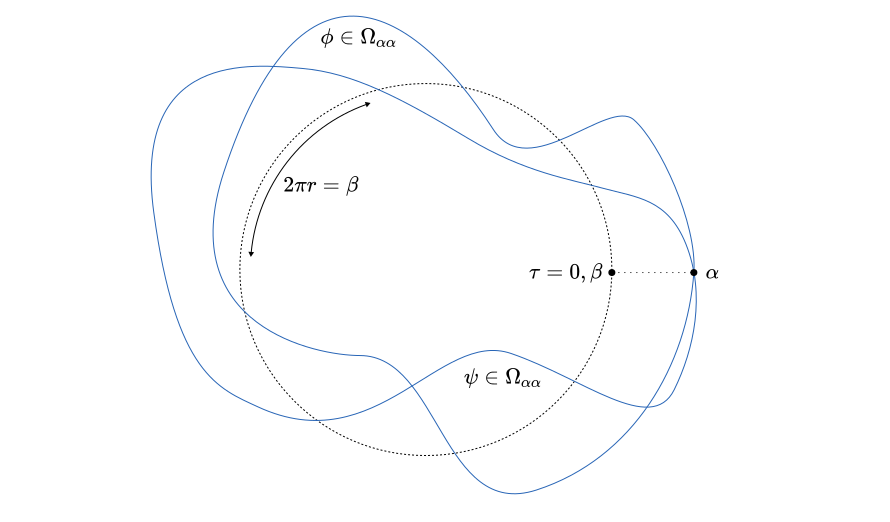
In this picture we have a circle with perimeter
where the integral is taken over all the fields in this new compactified configuration. With this motivation we are ready to rigorously treat the free field theoretic partition function.
Free Bosonic Theory Partition Functions
We want to consider a free bosonic theory and calculate its partition function. To do this we assume that underlying spacetime is some Riemannian manifold
where the wedge product incorporates the bundle metric on the fibers of
We also pick a metric on
where
where we have used some functional integration techniques from Peskin. To evaluate this determinant we need to find the eigenvalues of
Lemma: Let
Now we are ready to do this! Now, however, we have a different metric in our circle such that the integration measure yields
instead of
where
This has the following interesting consequence.
Corollary: Any field
Notice that
The really interesting thing is that we are rarely interested in the partition function itself, but rather in its log and its derivatives. Therefore we only need to calculate the log of the determinant of
Proposition: The logarithm of the partition function is given by
up to some real number
Proof: We use the fact that
The trace is much easier to calculate than the determinant, especially since we have found a basis for all the fields given by
where
Corollary: The trace of
where
Proof: First let's see what happens when we calculate
if we define
The reason why this is nice is that for an eigenvector
Therefore the trace of the log, its going to be the sum of the eigenvalues which is given by
With this we have proven the statement.
Ok, but while this calculation was satisfying it is still not interpretable in a nice way. In particular, we would like to get some thermodynamics out of this about the particles of the theory in some ensemble. So let's start noticing some things.
Lemma: The following identity holds
Proof: Consider the identity
Then we can take
By differentiating we deduce that
On the other hand
Equating we obtain the identity.
In addition to this silly proposition we also need to remember that the partition function is the same up to a constant factor (i.e. independent of
where
where we have been dropping terms independent of
which is the partition function for Bose Einstein! Yey. This includes the energy of the vacuum so we can subtract it because by definition we pick the vacuum to be at
Theories with Interactions
Now that we have some calculations under our belt, it is time to play around with theories where interactions can happen. Such theories have action
where
Since we are not interested in the partition function itself, but its logarithm we can write
where
The Generating Functional
We often use the partition function as a generating functional for the correlators, so it would make sense for us to do it here too. Here is how to extend that definition.
where
The Matsubara propagator satisfies the equation
where
First order corrections to the propagator
It is clear that one can obtain the propagator using the generating functional above. Now we can calculate its first order correction in the coupling, using Wick's theorem.
The 2-point correlation function is given by
To first order we can approximate this using perturbation theory on a well defined potential term. However, we often want to calculate such expressions in momentum space (in order to define things like polarization etc.). This results in ugly expressions involving sums over all the Matsubara frequencies so we would really like to figure out a way to do this in "real-time."
Real Time Formulation
For real time we have found all our expressions in the compactification of the Euclidean space that we got access to through Wick rotation. What we want to try now is to motivate how the formalism exists back in the Minkowski space. We will start by motivating this through the definition of Feynman rules.
Feynman Rules for
Consider a Lagrangian with interaction term
This is exactly the same generating functional as the one we had for
-
The integration measure in momentum space becomes proportional to
-
And the vertex lines get delta functions on the momenta and positions which implements "momentum conservation" but with different normalization.
Complex Time ordering
One could now notice that the measure in momentum space could be written (with some appropriate meromorphic functions) as a integral over an carefully chosen contour over the full (not compactified) space. Therefore we could use that to move to the real time picture via introducing a consistent notion of Time ordering.
Definition: A thermal Green's function ordered on a contour
where
where
The the
The thermalness of the propagator depends on the path we choose we will soon find conditions on what this path should be, but for now let's try and see what implications does this have on the propagators.
Propagators
Not any curve
Therefore we can consider curves of the form
Additionally we want the 2-point functions to be defined by
where
Theorem: The following is true regarding the 2-point thermal correlation function
where the addition is understood to apply at the time component, i.e.
Proof: To show this we need to expand things slightly, namely
By the way, this implies the need for periodic boundary conditions on the time axis but in a slightly more general way that applies to the real time formalism also. Now we are ready to continue with our derivation of the propagators.
Consider the Fourier transform of the correlation function
The Fourier transforms (using translation invariance) have the property that
This results in the fact that we can write the propagator as
where
and
Proposition: The following identity holds
Therefore the propagator can finally be written like so.
Lemma: The thermal propagator on path
Proof: This is done by writing the propagator in terms of
This is an awesome result because it simplifies so many things! For example, we can derive the free propagator by taking
Contours for the Real Time Partition Function
One of the weird results is that the real time propagator is not the analytic continuation of the imaginary time (Matsubara) propagator. Here is how to calculate what it actually should be.
What we will derive is that we need to double the degrees of freedom of our theory in order to obtain the real time propagator. To do this we will find the path
Essentially the 'thermal' condition is the thing that we derived earlier. A field is thermal if it is
Let's go back to the partition function which we calculated by the trace
What we secretly did here is that we said that the integral over the field in "real time" that appears in the action, is the same as the integral over the fields in "imaginary time" because the action is not expected to have any singularities in the contour below.
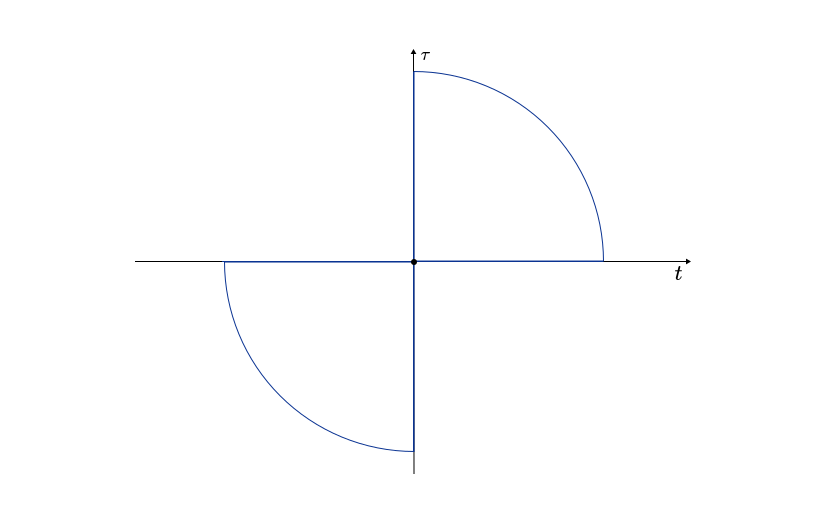
So what we said was that as long as no singularities are present on the two quadrants, the total action on a field analytically continued to that contour will be zero. Therefore we can split the action into contributions from the field on the real part (which is the action that we have started with) and contributions from the imaginary part, which is the action we are using in the "imaginary time" formalism. Then we applied the boundary condition by the trace to obtain functions that are defined on the following contour.
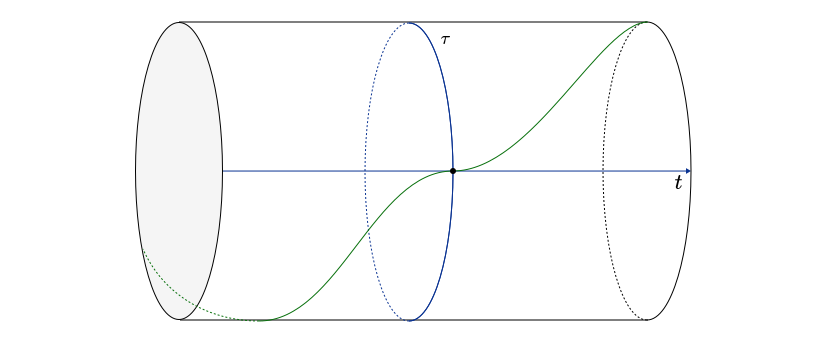
In this picture we have drawn the semicircular part of the contour that we take to be asymptotically far away with green. This is to illustrate that the action of fields defined on this contour vanishes as the contour is taken asymptotically far away.
Ok, but so far we haven't actually introduced an equivalent thermal field that lives on the real line! To do this, we can introduce the following contour on the complex plane and then compactify, i.e. add the trace boundary condition, to see what's up.
| Real Time Contour | Compactified Real Time Contour |
|---|---|
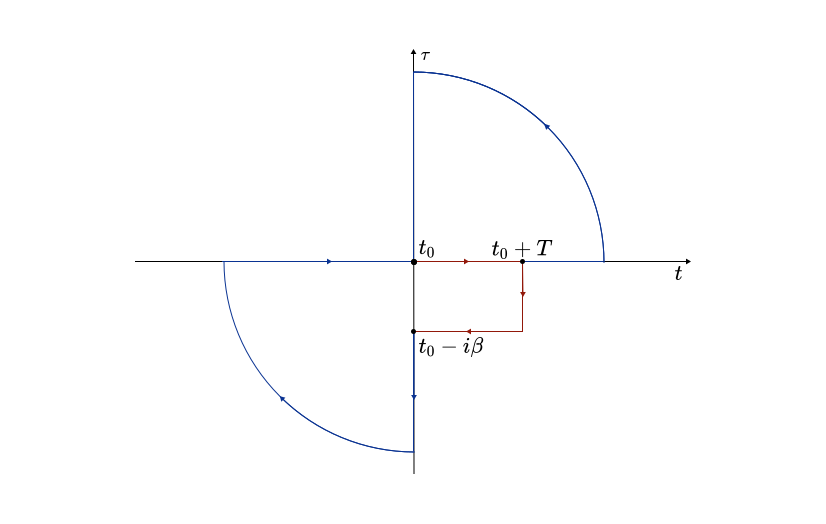 | 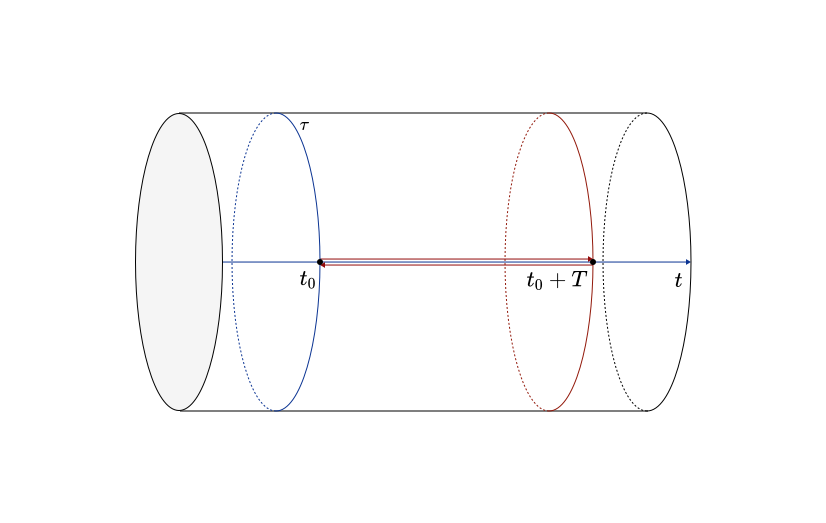 |
In the compactified picture I removed the lines that were drawn in Green before because this would have been too frustrating to visualize. Here is how we construct the new contour. We pick a time
While this cancellation doesn't always happen there are ways to take limits of this contour such that it does. One such limit, for example, would be to move the two parallel red parts arbitrarily close to each other. Yet after such cancellation what we are left with is the contributions to the action by two fields that live on the red parts! This is awesome!
By definition if there are no singularities enclosed, the contributions by fields on the two contours should not vanish, but the price we paid is that we have introduced two copies of the system. Therefore the real time, thermal action doubles the degrees of freedom of our theory in order to calculate the partition function by "integrating in" a copy of the system.
Relating to the Propagators
The effective result of this, is that the thermodynamic corrections will yield mixing terms in the propagator between the two fields. This sucks a little, but often we can diagonalize the two fields to obtain the real time propagators.
If we consider
where
where
where the orthogonal matrix
where we derived
Self Energy
The self energy can be calculated with its usual definition in momentum space
but now this is a more complicated matrix equation. Nevertheless, using the diagonalization matrix
Finite Temperature Gauge Theory
The whole point of this introduction was to introduce finite temperature Gauge theories. The reason is that gauge fixing at finite temperatures is less trivial than it was at
Incorrect Free Energy
Since we didn't need ghosts for quantizing Abelian Yang Mills let's try and do this thermally and see if it this is still valid. Essentially all we needed to do was to quantize a gauge theory by picking a gauge.
Let's do everything in the Feynman where we have picked this
and we impose the equations of motion coming from the Lagrangian
Now we can mode expand
where there are 4 polarization vectors. Notice that the constraint equation,
for any physical states
However, if we do the same thing in some physical gauge like
for some vector field
where we can see that the polarization vectors are only two!
While this doesn't matter at
Specifically the free energy is given by
In principle we can write the Hamiltonian as the sum of identical single mode Hamiltonians which will result (by permutation and re-parameterization symmetry of the trace) to an overall power on the partition function. In terms of the free energy, which gives directly the black body spectrum, that becomes a factor in front.
One theory has 2 polarizations while the other has 4! Where is the mistake?
The mistakes comes in the fact that while all the operator statements are true the Hilbert spaces we are taking the trace over are different. In most cases in QED we don't actually calculate such traces therefore this never becomes an issue. However, we already know how to fix this issue! The answer is to introduce Ghosts!
Rescuing the Free Energy with Ghosts
We introduce Fedeev-Popov ghosts to properly quantize the electric field in a covariant way. Without delving too much in the formalism we will introduce the following identity.
Theorem: Let
where
In physics we often call
Definition: Given a gauge fixing function
Where
Usually the determinant of the Jacobian is quite a pain to calculate in practice, however there is a lemma that can help us make it easier. To derive it we need a precise definition of the Jacobian.
Definition: The Jacobian of a gauge fixing function F is the variational differential with respect to the action of a lie algebra element of the gauge group. In particular let
where
Lemma: The following identity holds
for Grassmann fields
These are the Ghost fields! By integrating them in to our partition function we guarantee that the gauge is fixed, and we no longer have to worry about miscounting degrees of freedom or whatever. Let's see this in practice.
Working in the Feynman axial gauge we have that
carrying out the calculation we have that the effective Lagrangian after the introduction of the Ghost fermions
Up to a total derivative
where
Therefore the free energy is given by
picking the same basis that we have found before for the compactified space we can diagonalize and with a bunch of effort derive
Now for the other gauge, we have that
where
which results to
We can see that the two partition functions are equal! And that is because the ghosts thermalize at nonzero temperature enough to cancel the degrees of freedom obtained from the nonphysical gauge freedom.
Photon Self Energy at Finite Temperature
Let's do some QED. The first thing we haven't addressed so far was the introduction of the chemical potential. As we know from general statistical mechanics, for any conserved charge we can thermally control it in a grand canonical ensemble by introducing an associated chemical potential
Let's do this for the
where
Therefore the partition function is now
This really implies that we have changed the Lagrangian of QED to be (in Feynman Gauge)
Here we have incorporated the Gauge fixing term, ghosts, and the fermions
Once we have the propagators we can actually calculate the polarization by following the standard prescription. Use symmetry arguments (Ward identities, transverse and so on) to constrain the tensorial structure, and then BRST (or what's left or it in the Abelian case) to constrain the rest of the parameters.
So we need the propagators. Luckily we can calculate them with the prescription mentioned above through their regular values. We get
The interesting thing is that the propagators simply pick up an extra term that corresponds to the distributions
Following the prescription of determining the vacuum polarization we can use symmetry to constrain its tensorial structure like so
where the
so we can express the probabilities for transverse and longitudinal momentum modes. After calculating the actual value and getting the zero modes we finally see that
After calculating these propagators we get the following limits
where
This result implies screening of the electromagnetic interactions with screening length proportional to
Spontaneous Illegal Interactions
Having the photon polarization we can calculate s-matrix elements for things that would otherwise vanish. In particular we can have spontaneous pair production! Which I think is pretty awesome.