Axioms in 2D CFT
Here we build 2D Conformal Field Theories from an axiomatic point of view and calculate some basic results in this language.
Axioms in 2D CFT
Operators in CFT
Quick aside on the domain of operators
Field Operators
Conformal Transformations
Conformal Transformations in
Setting for Axiomatization
Conformal Group
Correlation functions
Reconstruction of Field Operators
Conformal Ward Identities
Energy Momentum Tensor
Physical Motivation
Virasorization of our Hilbert Space
Definition of a 2D CFT
Operator Product Expansion
Local Symmetries (Where are the Verma Modules?)
Wick's Theorem and Normal Ordering
Aside on why Virasoro
Operators in CFT
The first and potentially most important step in understanding the propagators in CFT is to understand the operators and their structure. We begin by describing a hilbert space of states, defining its properties and then talk about operators on the hilbert space. Then we will talk about operator valued distributions there that are what we call operators in CFT. Finally, we will prove certain niceness properties between them and the hilbert space.
Definition: A quantum Hilbert space is a separable Hilbert space with hermitian inner product.
This has all the niceness properties of the hilber spaces that we want. Now it’s time to start thinking about operators.
Definition: A unitary operator
Notice that these operators do not have to be bounded or have any other niceness properties. What we would like to do is to create maps from our base manifold to operators. However, this is not good enough. Since we only care about what happens in regions of space and not in points the natural object to talk about is distributions, which encompasses more stuff than normal functions.
Quick aside on the domain of operators
Now the next question is: should we restrict the definition of operators to a function defined in the entirety of the Hilbert space? The answer is, surprisingly, no!
Infact this is not even a new idea, we have implicitly been doing it in physics for ages! Think about any continuous function
Proposition: Let
Which means that if we only were to have
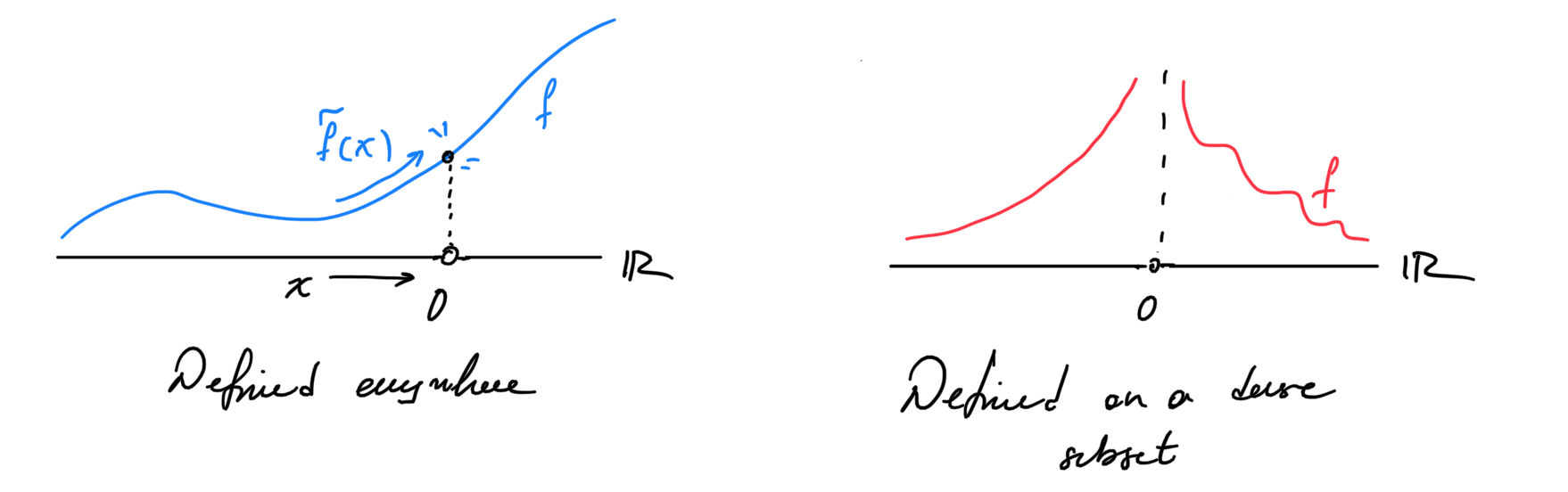
Ok, so what? Well in physics (unfortunately) things are almost never defined in the entirety of space. But they are almost always defined on a dense subset of it. Think of the charge of a test particle. It is defined everywhere but the origin. Therefore, if we were to develop a theory of physics that only works on functions that are well defined everywhere, we would have to exclude some of these very real cases!
Therefore, we have to make our physics work using functions that are not necessarily defined everywhere, but are at least defined on a dense subset.
But if we are not considering some points in the entirety of space won’t we loose information about them? The answer is no! In fact that’s what we’ve shown in the previous proposition. If the function is continuous everywhere, then we can recover its value everywhere from any restriction to a dense subset. So we have lost nothing. On the contrary we have gained a richer tool to talk about functions.
Often, this remains unsaid, because it is a REALLY subtle point that at the end, ends up changing nothing in day to day calculations. But we do use it every time we change to spherical or cylindrical coordinates which I think is pretty cool.
On the matter at hand, when we are trying to axiomatize something as complicated as QFT we need to take into account the same subtlety. We don’t just wanna study operators that map from the entire hilbert space, we want to do it for ones defined in a dense subset of it. So let’s start building on that
Ok now that we have motivated the need to talk about operators from dense subsets of the hilbert space other than its entirety let’s try to define them!
Definition: An operator defined on a quantum hilbert space
TADAAAA!
This is a really nice definition.
There is one more point of subtlety, we want to talk about operators that are self adjoint, and the way that we defined them is a bit iffy, so let’s write it down.
Definition: An operator
An operator is self adjoint if
The adjoint still means the same thing, but we had to be careful about where it is defined (sorry this is the price we pay for restricting our domain).
Field Operators
The next step is to talk about the concept of a field operator. This is a bit harder to define. What I picture as a field operator is simply a map that takes a manifold and assigns an operator to its every point. Obviously, this is quantum mechanics so it doesn’t work. But why?
The central object of quantum mechanics is not really the value of the field itself, but rather expectation values of stuff. We don’t care about what happens at a particular point, we always care about what happens on average in a region (that could be arbitrarily small). By restricting ourselves to thinking about functions we are loosing the ability to talk about regions. Perhaps some functions are not ingerable in some regions, or perhaps some information about a region could not be expressed in terms of functions. That’s why we create distributions. So we are going to use those to define our field operators.
Definition: An operator valued distribution on an open subset
Definition: A field operator or a quantum field is a local operator valued distribution on some manifold
such that there exists a dense subspace
- For all
- The induced map
- For all
The set of all field operators is denoted as
The first condition is to say that every operator that we attach is densely defined in a way that if we compose all of them we will still have a densely defined operator (we won’t accidentally remove a chunk of our Hilbert space that we can’t take back). The next condition is that we want this to be linear in the dense domain shared by all, and finally that if we fix two states we want to get back a distribution. Also there is some small abuse of notation. While
Conformal Transformations
In order to fully understand the requirements for something to be a conformal field we need to consider how do things transform under conformal transformations. We begin by considering the definition of conformal transformations through the metric. Then we study how maps and distributions transform and then we impose this condition on our conformal fields.
Definition: Given two Riemannian Manifolds
Note that a priori a Weyl transform does not tell you anything about the metric
Definition: Let
where
This is suuuper confusing. To unpack first we understand that
The pullback of
In other words it is telling you how
So this was easy (lol). In this notation
In other words we see that
Nice. What that means in practice is that these transformations are coordinate transformations that preserve the angles. THEY DO NOT CHANGE THE METRIC! The length of any vector remains the same, the length of any path remains the same. This is a really crucial subtlety. The map mapped us between the same manifold with the same metric, the condition with the pullback was to make a statement about how it does it, not how it changes the metric.
Conformal Transformations in
When
Theorem: The conformal transformations in
Proof: Let
Notice that in order for this to be conformal we need to at least have
Therefore, either
Which also shows the sign enforcement as well.
Now consider a tensor field
where
Setting for Axiomatization
What we aim to do in the following is to define a set of axioms such that we ensure a duality between Field Operators and States or elements of the chosen quantum Hilbert space. In reality we do not really care about the fields themselves. What defines the theory is the correlation functions (i.e. the green’s functions) that are constructed through vacuum expectation values of field operators. This will make sense as we go along. To start with we need some defintions of the nice spaces we are working on.
Definition: The ordered configuration space of
Then the time ordered configuration space is the subset of
This is the space where all the points have coefficients in the positive half plane. So if there are many points at some time and space we just put them all together. We will drop the
This is already a pretty good starting point, the next step would be to force something else on the base space. We could force that the order at which the configuration is taken does not matter. In practice this means that for any point
Definition: The permutation action of on
We use it to define the space where the order does not matter!
Definition: The unordered configuration space of
Similarly the time ordered unordered configuration space (lmao I love the name) of
I know I have spent a lot of time showing these stuff, however, they will lead to real simplification in a second essentially implementing locality in our correlation functions.
The next step is to define the spaces of Scwartz functions on these sets so that we can define operators very soon. In particular they are defined like so
Definition: The space of rapidly decreasing functions of
where
Now we will start with the axiomatization of the theory. The first thing we want to construct is to define the set of all propagators and give them the right properties under conformal transformations.
Conformal Group
We have talked about the Witt Algebra in detail and showed how the generators look. The important corollary is that the following generators under matrix multiplication form a group called the conformal group which is the group of transformations we want our theory to be invariant under.
Definition: The Conformal Group is the group generated by the set
where
Propostion: The conformal group is isomorphic to
Correlation functions
Here we will first give an intuitive picture of correlation functions just to illustrate how important of a role they play in this. In QFT correlation functions are the result of taking the expectation value of an operator composed by acting with the field operators in a time ordered way. Now we are ready for a formal definition of
Definition: An
where
The important thing to notice is that this definition implies that there aren’t many choices for these functions. Let’s look at the following proposition.
Proposition: Consider an n-point correlation function
- if
- if
We can keep deriving these identities, but this is amazing! We could just use contour integration to figure out anything about the correlation functions, simply by knowing their weights.
Reconstruction of Field Operators
With a given set of
Theorem: (Reconstruction of Field Operators) Given a set of indexed correlation functions
and if
Note that when we say
Ok! Now we are cooking! We have our field operators, even somewhat haphazardly, so now let’s try to figure out what they really mean.
Conformal Ward Identities
Let’s study those correlation functions a bit more in detail and develop some tools that will be useful for calculation. These are called ward identities.
Theorem: (Conformal Ward Identities) The transformation assumptions of correlation functions under
We use these identities to further restrict the form that the correlation functions can take. We will see it in practice later, but they are important to mention here.
Energy Momentum Tensor
The central object that encodes our physics is the stress energy tensor of the theory. Here is a definition for it.
Definition: An energy momentum tensor is 4 quantum fields
- It has scaling dimension
Corollary: (Properties of the Energy Momentum Tensor) The axioms of the energy momentum tensor and the covariance properties lead to
- The quantum field
- The quantum field
Physical Motivation
So far these constructions have been introduced without any motivation, so let's introduce the usefulness of the stress tensor as an object in our CFT using some physical motivation and variational calculus. We will also derive the ward identities to justify their almost axiomatic presentation above.
As we have shown in an example, a stress tensor
where
Virasorization of our Hilbert Space
We derived this object because it will give us the symmetries of our theory. Let’s do some groundwork
Consider the following operators in the quantum Hilbert space
The integral here is well defined since
Proposition: The operators
HELL YEAH! We found it! We have found our symmetry algebra. Now we can do something else that is cool, we can reconstruct the stress tensor
Corollary: (Stress Tensor Reconstruction) It follows that given these two representations the stress tensor components can be obtained by
This is amazing! We essentially have found that the stress energy tensor yields a unitary representation of
Lemma: (Decomposition of Hilbert Space) Under the Virasoro representation of defined by the stress energy tensor
If this decomposition is finite, we call the conformal field theory minimal.
Definition of a 2D CFT
Now we are ready to define a conformal field theory. (This is useless, but cool)
Definition: A conformal field theory for a countable index set
YES! This is it! Isn’t this amazing? The following corollary summarizes what we have done so far.
Corollary: For any conformal field theory
Now that we have something, let’s look at some examples
Example: (Free Boson) Consider a complex scalar field
Where the metric is given by
Let’s find the green’s functions to do so we will rearrange using Leibniz rule the action to obtain
Then we consider the set of variations
As a result, we have that the equation of motion is given by
Using variational principle we can calculate the the 2 point correlation function is
which is a really cute formula, essentially saying that this correlation can be split in two. In practice is does. From the equations of motion we see that
for some holomorphic and anti holomorphic functions
Now we see that
which we can see that is invariant under translations, and under scalings it just acquires an exponent to the power of 2! So this looks like it could be a conformal field with weights
Operator Product Expansion
The first thing we need in order to talk about this concept, which is super useful in calculation, is to get the Primary Fields. Let’s understand what they are.
Definition: A quantum field
where
Corollary: A primary fields satisfies
Ok this was kind of a lame corollary, but here is a cool one, which will help us introduce the Operator Product expansion.
Corollary: A primary field
Where the symbol
Honestly, I am not sure how to prove this, and I will get there eventually. However, here is what we mean by OPE.
Theorem: (Operator Product Expansion of Primary Fields) Any pair primary fields
where
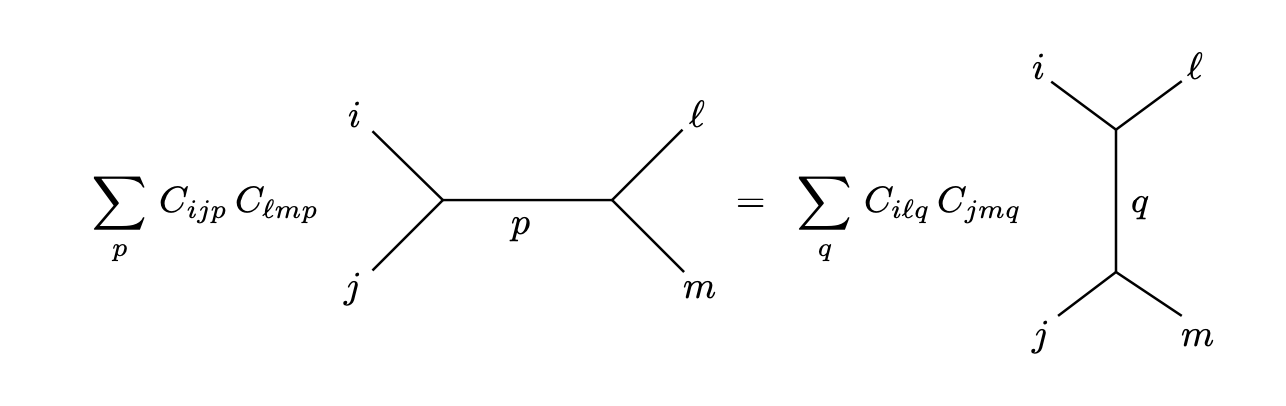
Remark: We usually require that in a CFT the OPE is associative. This really means that when we are expanding the vaccuum expectation values it doesn’t matter which field operator we take the OPE of first, we should obtain the same result regardless. This is sometimes known as crossing symmetry and all it really means is that the following diagrams evaluate to the same thing
Now we are ready to talk about an OPE in more generality.
Local Symmetries (Where are the Verma Modules?)
So far we have seen that by adding a stress energy tensor in our theory, we have effectively created a global representation of the Virasoro algebra. Here we will study local symmetry.
Definition: Given a primary quantum field
where
These are what we call asymptotic states, and they are very useful for starting to talk about highest weight representations of Virasoro algebra. Take a look at this corollary, which will be one of the very few here with proofs.
Proposition: An asymptotic state
Proof: We know from the commutation relations we derived that
Taking the limit we find that
Similarly for
This is a really cool result! Because we have now created a virasoro module!
Corollary: Given a an asymptotic state
with highest weight vector
Definition: A state
We usually think of those states as excited states. We usually require in addition that the descendants of the asymptotic states for all primary fields span a dense subset of the quantum Hilbert space. In this case we can decompose the Hilbert space into Virasoro modules using just the primary fields.
Definition: Given a primary field
where
for some
With this definition we have done multiple steps. The first one is that we have defined local generators for the Virasoro algebra
Proposition: For a primary field
When I read this, I was screaming to my computer that
Theorem: (Field Operator, State Correspondence) If the asymptotic states span and the descendants (i.e.
The corollary is that for any conformal family we can find a corresponding subspace in the Hilbert space with the same properties. So essentially, with this step we have managed to partition our quantum Hilbert space (or at least a dense subset of it) in Verma modules!
Corollary: For some field operator
But here is the thing. We know
Wick's Theorem and Normal Ordering
In calculating correlation functions we have a very useful tool in QFT that takes advantage of the noncommutativity of quantum fields.
Definition: Let
For more operators we do it for all possible contractions.
Aside on why Virasoro
It would be interesting to try and justify why the Virasoro algebra is the algebra that appears in the Hilbert space, even though the Lie algebra of the conformal group is the Witt algebra. In other words: Why the f** is there a central charge?
Usually the answer to this is: something something take OPE of
Observation: Any observable symmetry of a quantum system is a symmetry of its projective space.
This is important. In the Hilbert space there is some ambiguity (i.e. the overall phase) to define the possible quantum states. So if the representation of a group changes that exclusively changes that phase then that representation is trivial in the projective space. In other words, it will not change one state to another, so an experimentalist would not see it. Therefore, in a conformal field theory, the symmetry that we do, in fact, observe is the conformal symmetry, but on the projective space. So an experimentalist would see conformal invariance as a result.
One question is, if some group (or Lie algebra) has a representation of the projective space, does that imply that there exists another (aka a lift) on the corresponding Hilbert space? The answer is not in general! Not every possible representation can be lifted into a Hilbert space. However, we can do the next best thing.
Theorem: Given a representation
where
In other words, while it might not be possible to lift the representation to a representation of the same group, it is always possible to lift it to a central extension! That new element is the anomaly that is introduced in the Hilbert space and it characterizes the projective representation somehow.
To find weather this is possible we study the homology of the Group or algebra we are working with induced by the representation. This might be too abstract, but actually it isn't. Some day I will complete these notes saying how studying these homology groups is equivalent to studying the CFT on a cylinder, which is absolutely fascinating.