Inducing Topology Using Maps
We have previously characterized the set of all spacelike slices and eventually we want to add a nice and smooth structure on it so that we can start writing things down such as the kinetic energy of path from a spacetime with a black hole to one without. The first step is to define a topology, we do so using maps to topological spaces that have the properties we want and forcing them to be continuous.
Spacelike Slices
Let’s briefly and without motivation recall definitions for spacelike slices, even though we develop the following in greater generality below.
Definition: An
Note: Let’s drop the
Topology from a single Map
Let’s study inducing the topology on some space using a single map first, before moving on to using multiple maps.
Consider a map
Proposition: Given any map
defines a topology on
Proof:
Corollary:
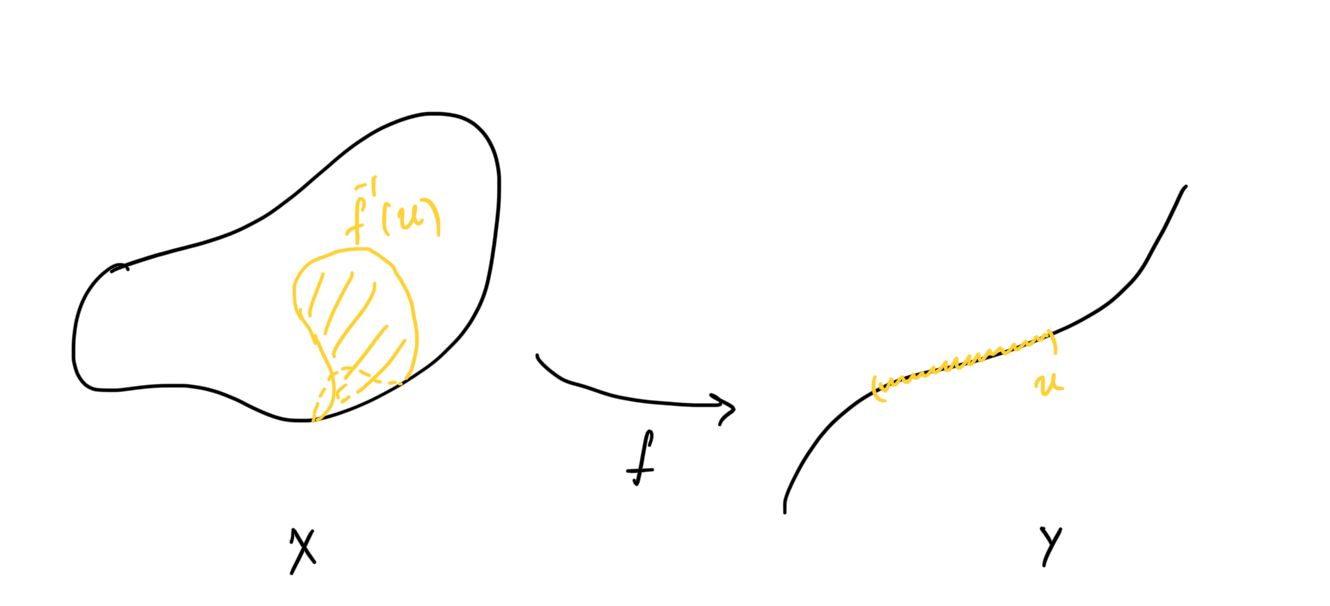
Ok so now we have a way of defining a topology for a space using a single map, but how about properties? Let’s restrict the possible maps that could work for this. Look at the following proposition.
Proposition:
Before we prove this proposition and have a nice discussion consider the following property which I will not prove
Property: Let
Proof (of proposition):
We can prove a similar proposition for second countability. Which is great because second countable Hausdorff spaces have a shit ton of properties that can help us.
Proposition:
Proof:
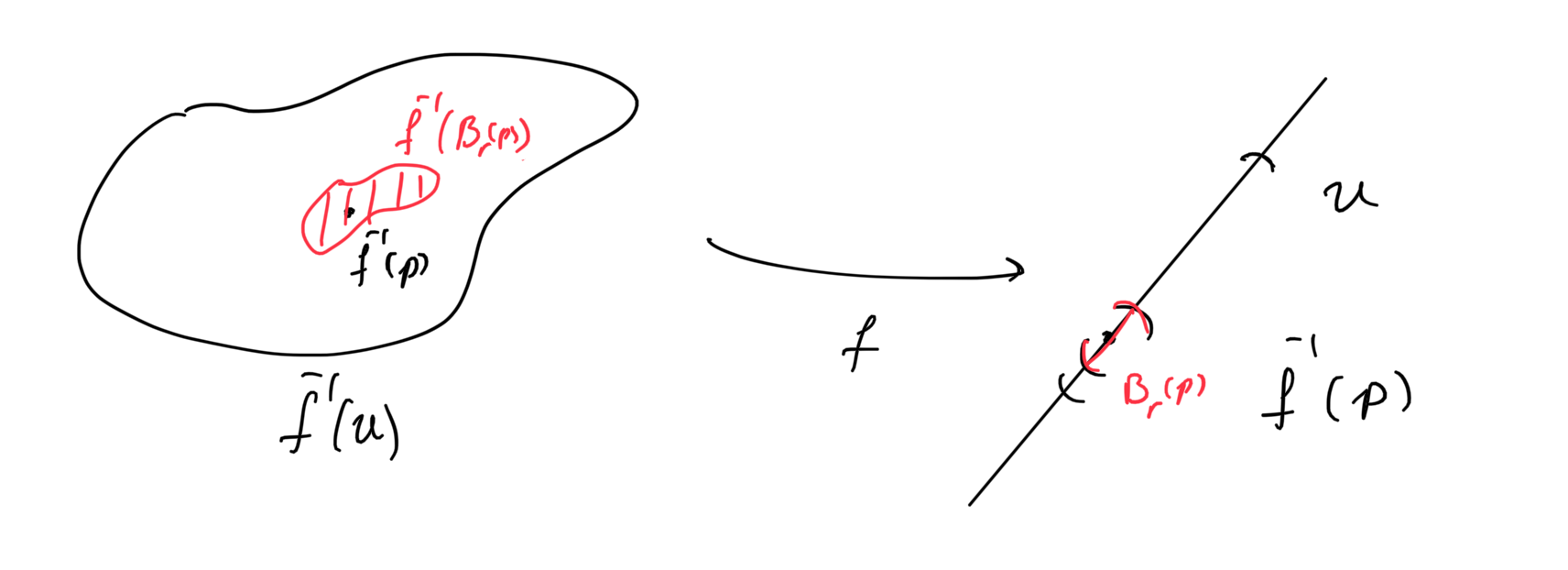
Note: Since we only care for Hausdorff spaces
Now we can build up to the next really useful theorem!
Theorem: (Topology Induction by a single map) Given a set
Injectivity Sucks!
The previous theorem is great because it shows us an equivalent condition for the topological space to have most of the niceness properties we require. Here is a glimpse of what we get by using an injective map:
- If a sequence converges the limit is unique.
- Baire Category theorem: Countable intersections of dense sets are dense. This is very helpful in characterizing the space later.
- If in addition it is regular (this is a weaker condition of normality), i.e. a closed set and a point outside it are separated by open neighborhoods, then
and more! Personally this makes me very happy, because the step for showing that
Yet injectivity is very strong. Who knows if we can even find a map to a second countable Hausdorff space that maps ALL THE (nice) MANIFOLDS!? So injectivity sucks. Yet we don’t have to give up. We can turn any map into an injective map by restricting the domain. So we can explore that
Proposition: Given a map
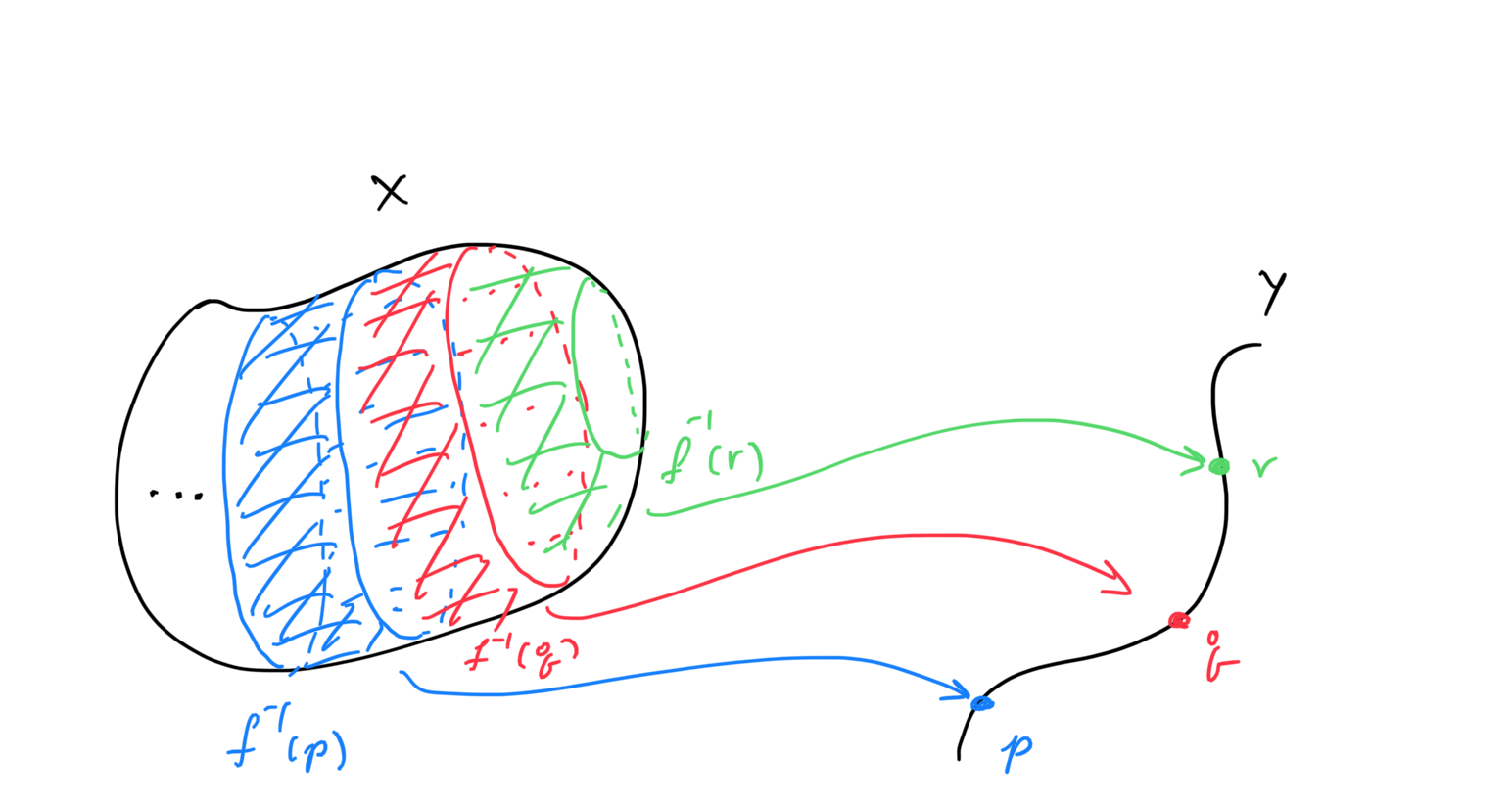
The equivalence classes referred to here are the fibres of
The obvious caveat is that we are reducing the original set
Inducing Topology from Multiple maps
We have already seen how we can induce a topology using a single map. Here we want to talk about a systematic way of inducing it using multiple maps. The answer to that is products. We will use maps to the product space and show a nice equivalence between other ways of using multiple maps to induce topology and using the product space. The reduction to the product space is nice because most topological properties still exist after products.
Proposition: Let
To extend this into infinite products we need two theorems.
Theorem: Countable products of second countable spaces are second countable. Products of Hausdorff spaces are Hausdorff.
Using the theorem above we can prove the following proposition
Proposition: Let
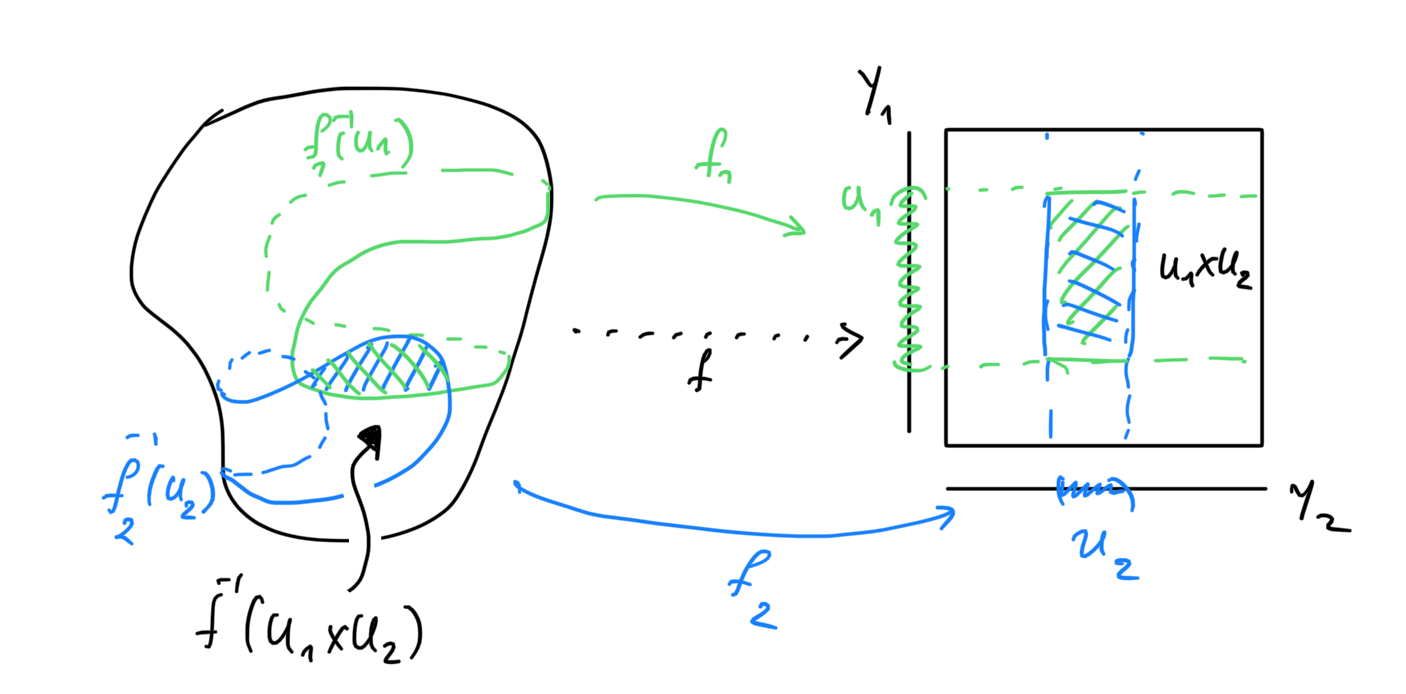
Corollary: The functions
This proposition is pretty cool because it transforms the question of constructing a topology using a countably infinite set of maps to studying a the one constructed by a single map. Also the image above gives an intuition for showing that every other way of inducing such a topology using multiple maps is equivalent.
In practice
By now we have the following cool results. We can induce a topology to any set using a map to a topological space that preserves second countability and Hausdorffness if an only if that map is injective. We have also shown that if we want to consider countably infinite maps then we can just consider the product of them as a single map and arrive to the same result.
The question now is “what map?” So let’s go back to our original problem where we consider inducing a topology on the set of all spacelike slices
Examples would be things such as the Riemann curvature, or the genus of the manifold, or other invariants.