Symmetry Braking
Consider a symmetric function
If we do a perturbative expansion around
where
is no longer symmetric a priori for
The discussion here is primarily drawn from these references
- Gauge Theory and Variational Principles
- An Introduction to Quantum Field Theory
- Mathematical Gauge Theory
- Field Theory: A Modern Primer
In Classical Field Theory
Let's start with a formal description of Symmetry Braking in Classical Field theory.
Vacuum in a Field Theory
We will define vacuums and chop up our symmetry accordingly. But first let's introduce a useful tool
Definition: Let
Note: the bundle lift depends on the trivialization.
Definition: Let
This is a disgustingly complicated way to say what we all think when we think of a minimum. Gradient zero, and Hessian bowl.
Definition: Consider a Lagrangian
where
is called the vacuum orbit. We usually denote the fibers as
is called the unbroken subgroup of
Ooof. This was a lot of setup. And while the elements, such as Principal and Associated Vector bundles are explained here, they are only there to provide the natural calculus structure that we usually take for granted in physics. In essence, a vacuum is a field configuration that minimizes the potential of our theory. Here is a picture of what is going on.
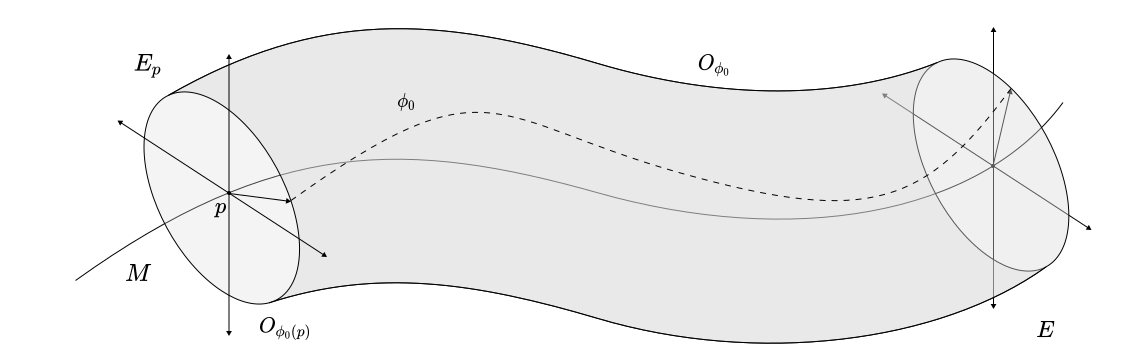
The interesting theorem that will lead to the creation of Goldstone Bosons is the following.
Theorem: Let
where
Proof: The proof of this theorem is based on the fact that
This is because any
The only question is to show that we can form a basis for
Therefore, this isomorphism of Lie groups, induces an isomorphism of the Lie algebras. So we are done!
Goldstone Bosons
A vacuum is the fundamental ingredient of symmetry braking. Now that we have it, we would like to create a field theory around deflections from this vacuum. Here is how we do it.
Definition: Let
where
Side-note: Notice that the vertical tangent space
Definition: If
Lemma: The vertical tangent space
Proof: The proof of this is directly taken from the last theorem above in the previous section.
So we can have an interesting approximation of the Lagrangian.
Corollary: The Lagrangian can be approximated in terms of the shift field as
where
Proof: We use the fact that
Definition: We can write the shift field in the basis above like so
where
Theorem: (Goldstone's Theorem) A theory with a vacuum admits as many Goldstone fields as independent broken generators of the Lie algebra.
Proof: We have already shown this in the previous lemma. This just combines it with the definition.
Linear
As an example we will follow Peskin to construct the Goldstone bosons that arise in the symmetry braking of the Linear Sigma model.
Definition: Let
where
This is not a gauge theory (even though it actually is because the frame bundle of this is a principal bundle with fiber
Proposition: The linear sigma model Lagrangian is invariant under the fundamental action of
Proof: Let
Therefore we see that for any
Additionally consider
With these two identities we can show that the Lagrangian remains invariant, i.e.
So now we have a group that the Lagrangian is invariant under, and more importantly, that the interaction term
is invariant under the action of the Lagrangian and it is a bundle lift of a function
Proposition: The section
is a vacuum for the linear sigma model Lagrangian.
Proof: The minimum of
Therefore, for this to vanish we need
Also we can take the second derivative to obtain the Hessian to be
We see that
Out of sheer luck for this case notice that
Proposition: The Lagrangian can be written as
Proof: This is a direct application of the last corollary of the previous section.
The cool thing though is that this new theory, to this approximation, is a theory of
In Quantum Field Theory
Through the path integral formulation, all of our previous understanding can be directly ported through in our quantum theory. However, this picture hides itself once we start to renormalize. In this section will will go through the renormalization procedure of the linear sigma model and show some ugly outcomes. Then we will look more specifically into quantizing spontaneously broken gauge theories.